Ethnic Slurs Haunt Alexey Navalny
Alexey Navalny came under harsh criticism from Russian opposition movement colleagues as soon as he was released from Kirov jail on a “podpiska,” (an agreement to stay at his current place of residence — the Russian equivalent of making bail), and as soon as it became clear that he would continue to run for mayor of Moscow throughout the appeals process for his 5-year long prison sentence.
These fair-weather enemies restrained from public disagreement while it appeared that Navalny was getting the full brunt of government persecution in a trial most view as unjust and political in nature. However, now that Navalny stands a chance to keep himself out of prison by garnering a critical mass of public support in the mayoral elections against current mayor Sergey Sobyanin, the flood-gates have opened. First, Evgenya Chirikova, environmental activist and former opposition darling with her own mayoral ambitions [GV], wrote a harsh blog post [ru] attacking Navalny for skipping the environmental policy section in his electoral platform [GV].
Navalny responded to Chirikova's criticism promising to include the environment, but could not refrain from dismissively joking that her and her supporters would be distributed propaganda materials made out of “sticks, moss and tree bark. [ru]” It is partially his abrasive sense of humor and uneven tone that got Navalny in the next bit of trouble. The same day that Chirikova wrote her blog, Deputy Editor-in-Chief of Moskovsky Komsomolets Ayder Muzhdabaev wrote an open letter [ru] in his Facebook asking questions about the opposition candidate's perceived nationalist views.
Navalny has never hid his sympathies for the Russian nationalist movement — only a few weeks ago he co-authored a statement on ethnic violence in Pugachev [ru] with prominent nationalist opposition leaders. Muzhdabaev's questions, however, were much more personal. In particular, he addressed allegedly racist episodes in Navalny's biography — one in which he reportedly called a female Azerbaijani co-worker a “darkie” (“chernozhopaia,” literally “black-assed”), and another in which he referred to Georgians as “rodents” (a play on words: Gruziny (Georgians) and gryzuny (rodents)) during the 2008 Russo-Georgian War.
Navalny's answer wasn't gracious. He started by tweeting [ru]:
Мой штаб требует, чтоб я ответил на какое-то отвратное открытое письмо. Ненавижу такое. Бездарная потеря времени. Тошнит просто
— Alexey Navalny (@navalny) July 22, 2013
My staff demands that I answer some kind of disgusting open letter. I hate stuff like that. Total waste of time. It sickens me
With a mindset like this, it's no wonder that Navalny ended up with a letter [ru] that can be described as patronizing. After prefacing with how much he dislikes writing answers to such “pointed” [the scare-quotes are Navalny's - A.T.] questions, and how he is going to do it anyway because its his “duty,” Navalny petulantly wrote that he has already answered them 138 times (later he upped that figure to 138,000). At one point he started an answer with an exasperated “Hellloooowwww.” In fact, Navalny seemed so rude that some people drew comparisons between him and President Putin. Olga Allenova, a Kommersant journalist, wrote [ru]:
Этот хамский, снисходительный тон в ответах журналисту никого нам не напоминает? По-моему, парень - истинный преемник ВВП.
Does this boorish, condescending tone when answering a journalist remind you of anyone? I think the guy is a true successor to VVP [Vladimir Vladimirovich Putin]
Journalist Stanislav Minin made a similar connection [ru] to Putin's patented “macho” style of answering questions.
Rudeness aside, the biggest point of contention turned out to be the alleged ethnic slur against Saadat Kadyrova, who worked for the Moscow office of the opposition Yabloko party in the early 2000s together with Navalny. While in the original letter Muzhdabaev referred to statements that Kadyrova herself made about the incident (probably this Novemeber 2012 interview [ru] with Kadyrova where she says that Navalny's behavior forced her to leave the party), Navalny chose to interpret the question as referring to a blog post by a different former party colleague. He linked to a November 2011 post [ru] by Engelina Tareeva, an 88 year old woman who briefly mentioned the incident in her LiveJournal, but seems to have a generally positive view of Navalny. In this way Navalny evaded answering “Yes” or “No” to the original question, instead intimating that the incident was simply imagined by a half-senile “grandma” who only saw him a few times at the office.
This claim forced several of Navalny and Tareeva's Yablko colleagues to chime in with their own recollections. Semyon Burd, former Deputy Chairman of Moscow's Yabloko, wrote [ru]:
Вот лжет и не краснеет. Я несколько раз был свидетелем длинных разговоров Энгелины Борисовны и Алексея в 101 комнате. Она работала много на выборах 2005 года, работала на телефоне, еженедельно рассказывала Алексею о своих результатах. [...] Энгелина Борисовна была членом регионального совета, где Алексей Навальный был заместителем председателя. А теперь она стала бабушкой, видевшей его несколько раз в офисе.
He's a bold-faced liar. I have on several occasions witnessed long conversations between Engelina Borisovna and Alexey in room 101. She worked a lot during the 2005 elections, worked on the phone, and gave weekly updates to Alexey about her results. [...] Engelina Borisovna was a member of the regional party council, where Alexey Navalny was deputy chairman. And now shes suddenly a grandma, who saw him in the office a few times.
Another former Yabloko activist wrote [ru]:
рабочие места милой бабушки и Алексея Навального на первом этаже в период избирательной кампании разделяло метров десять [...]
the work spaces of the cute grandma and Alexey Navalny, on the first floor, during the election campaign, were about ten meters apart [...]
He also recalled Kadyrova, as did Alexander Gnezdilov (Alexandra Garmazhapova posted the following in a Facebook comment [ru]):
Александр Гнездилов пишет: “Когда в 2007 году Навального собирались исключать за национализм - Явлинский на бюро при десятках свидетелей напомнил Алексею об этом эпизоде и тот даже не заикнулся о том, что это ложь [...]“
Alexander Gnezdilov writes: “When in 2007 Navalny was being kicked out of the party for nationalism, during the working meeting [Party Chairman Grigory] Yavlinsky reminded Alexey about this episode in front of dozens of witnesses and he didn't even try to claim it was a lie [...]“
Tareeva herself also weighed in [ru], thinking that Navalny made a mistake:
Ему не нужно было отрицать общеизвестный факт, я имею в виду эпизод с азербайджанкой, зафиксированный в партийных документах. Лучше было сказать, что этот случай имел место, что то, что он сказал, он сказал в состоянии аффекта, а вовсе не по тому, что так думает, что он сожалеет об этом, и извинился.
He shouldn't have denied a commonly known fact, I mean the incident with the Azerbaijani girl, which was recorded in party documents. It would have been better for him to say that it did take place, but what he said he said in the heat of passion, and not because he actually thinks like that, that he is sorry for it, and has asked for forgiveness.
The preponderance of evidence seems to suggest that Navalny lied when giving his answer — in her interview, Kadyrova mentions the incident in passing, and does not appear to think that it's at all controversial:
Он вместе со мной начинал работать в «Яблоке». И когда-то я впервые услышала от Алексея Навального националистические высказывания вроде «вы — чернож…е», я рассказала об этом Григорию Алексеевичу Явлинскому.
He started working at Yabloko when I did. And when I first heard Alexey Navalny say nationalist things like “you're darkies”, I told Grigory Alexeevich Yavlinsky about it.
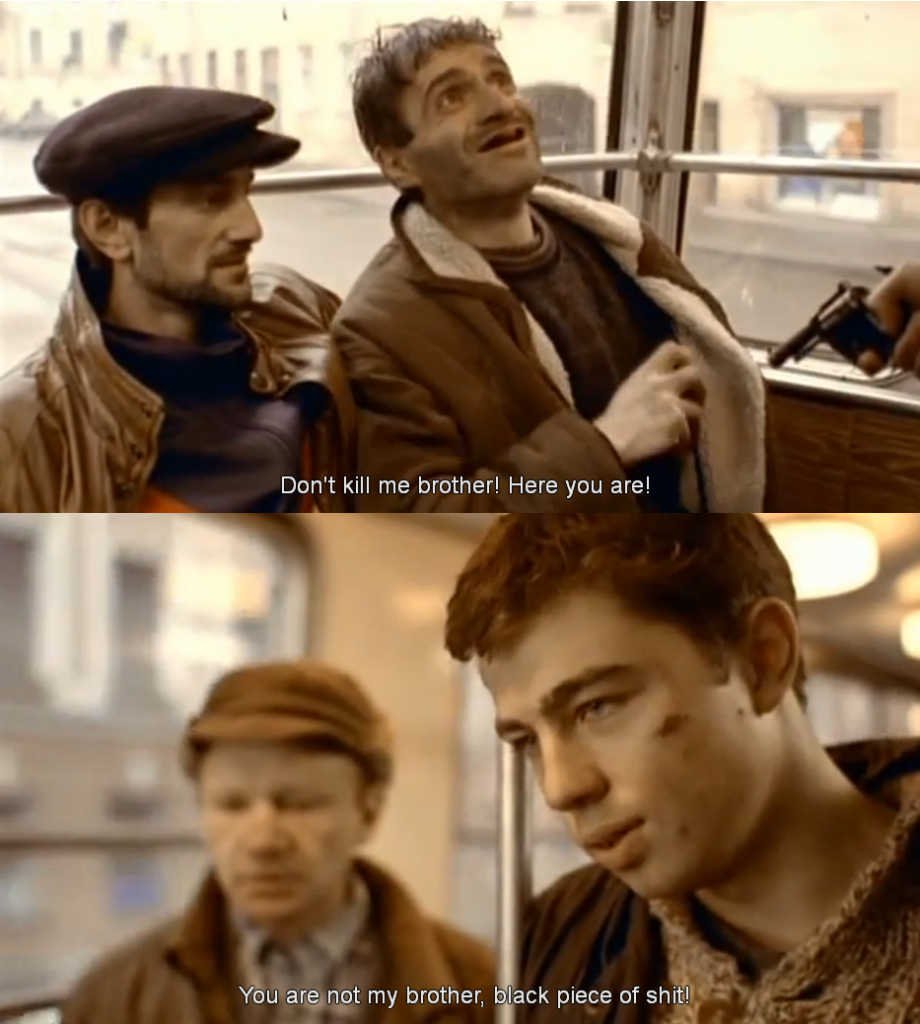
A scene from the cult 90s Russian movie “Brat” (Brother). A veteran of the first Chechen war, played by Danila Bagrov, forces two raucous North Caucasian immigrants to pay for their tram ticket at gunpoint. Bagrov's character uses the slur “chernozhopyi” to address the men. Some accuse Navalny of exploiting the anti-immigrant sentiments which made this scene popular. YouTube screenshot.
Supporters were quick to defend Navalny, whose situation is still precarious, but who at the same time stands a slight chance of changing the balance of power in Russia. Afisha's Yury Saprykin, for example, thought [ru] that it doesn't matter what Navalny really thinks or how he would act when in office — to him, the situation is akin to Pascal's wager, i.e. the worst thing that could happen is that Navalny turns into another Putin, and Russia already has a Putin, so it can only get better. (Even Saprykin, however, thought that Navalny needs to dial down his haughtiness when talking to critics.)
Some, like blogger Varvara Turova and LGBT-rights activist Maria Gessen, disagreed. Turova wrote [ru]:
Представьте, что у Путина есть брат-близнец. И он точно такой же человек. И он борется с настоящим Путиным. Будете вы за него голосовать?
Imagine that Putin has a twin brother. And he is exactly the same kind of person. And he is fighting the real Putin. Will you vote for him?
Gessen simply said [ru], referring to Navalny's ambitions of eventually running for President:
Я не хочу такого будущего, оно у нас и так есть.
I don't want a future like this, we already have one like it.
For some Navalny supporters his nationalism is a feature, not a bug. The journalist Oleg Kashin made this joke [ru] (in somewhat poor taste), for instance:
- Алексей, скажите, вы действительно назвали черножопой женщину из партии “Яблоко”?
- Да, а что?
-Alexey, tell me, did you really call a woman from the Yabloko party a darkie?
-Yes, what of it?
The publicist Dmitry Olshansky went further [ru], seeing a nationalist strategy as the only way forward for a attracting the electorate:
Если бы Навальный в сознании всех жителей РФ, кто о нем откуда-нибудь узнает, четко связался бы с идеей, назовем это так, этнокультурного замещения - 50% победы было бы в кармане. “Придет Навальный - выгонит всех этих”
If Navalny, in the mind of all the denizens of Russia who ever find out about him was clearly tied with the idea of, lets call it ethnocultural replacement - 50% of the victory would be a cinch. “Navalny will come - and kick all of these [people] out”
Perhaps he is correct — people of all walks of life seem to be sounding off about the “minority problem.” Former government adviser Alfred Koch, for example, wrote this [ru] about Muzhdabaev (an ethnic minority), who started the ball rolling with his questions:
Этот Айдер Муждабаев - банальный провокатор. Все так очевидно. Взяли нацмена и вот он задает “острые” вопросы с национальным орнаментом.
This Ayder Muzhdabaev, is simply a provocateur. It's obvious. They took a natsmen [old Soviet abbreviation from "natsional'noe menshistvo", ethnic minority, mildly derogatory/dismissive - A.T.] and now he is asking “pointed” questions with ethnic color.
With friends like this, who needs enemies? The satirical Twitter account IgorSechinEvilTwin (parodying the former deputy chief of Putin's administration, and current chairman of Rossneft) was on the same page [ru]:
Сергей Семенович, деньги на мочилово Навального выделять не нужно. Его поклонники справятся бесплатно.
— IgorSechinEvilTwin (@igor_sechin) July 24, 2013
Sergey Semenovich [Sobyanin], you don't need to find money for the Navalny-walloping. His own fans will do it for free.
Written by Andrey Tselikov
· comments (1)
Share: Donate
· facebook · twitter · reddit · StumbleUpon · delicious · Instapaper
Source: Global Voices Online » Russia
 (No Ratings Yet)
 Loading ...

 xxx
xxx


